The Broads
National park in England
| Coordinates: | 52.62, 1.52 |
|---|---|
| OS grid ref: | TG 38 08 |
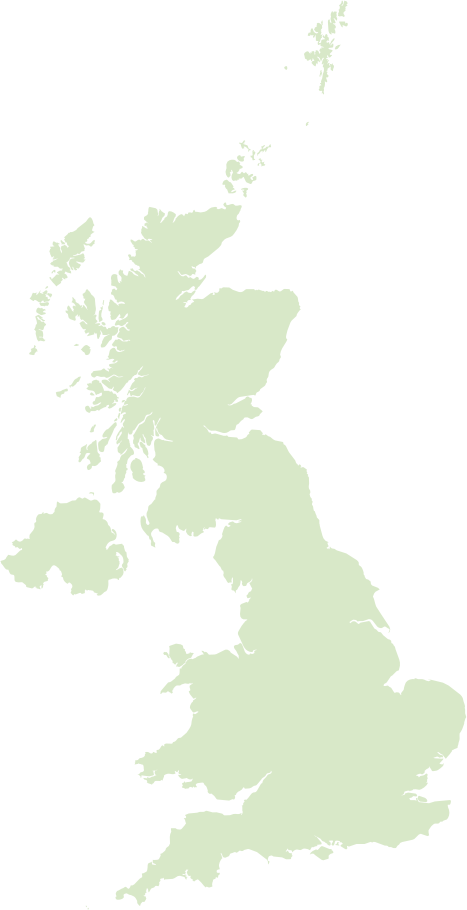
The Broads lies across eastern Norfolk and Suffolk, a low-lying network of rivers and shallow lakes covering roughly 300 square kilometres. The landscape is dominated by reedbeds, marshes and winding waterways formed around the valleys of the Waveney, Yare and Bure, and it has been officially recognised with national park status and governance by the Broads Authority.
The lakes - the “broads” - are largely the result of medieval peat diggings that flooded centuries ago, so the area has an odd mixture of natural wetland and human-shaped features such as windpumps and drainage channels. Historic river trade and the distinctive wooden wherry boats helped shape local communities, and many villages and grazing marshes still carry that fenland heritage.
The Broads is important for wildlife: extensive reedbeds and open water support breeding bitterns, marsh harriers and a rich suite of wetland plants and invertebrates. Conservation and flood management are ongoing challenges, and the patchwork of reserves, grazing marsh and navigable waterways makes it one of Britain’s most studied and carefully managed wetland landscapes.
Economically and socially the area lives by the water - hire-boating, tourism, fishing and reed cutting remain key activities - with busy gateway towns such as Wroxham, Beccles, Great Yarmouth and nearby Norwich linking visitors to quieter creeks and sailing channels. The result is a living cultural landscape where leisure, conservation and local livelihoods all revolve around the unique waterways.
Towns and villages in The Broads National Park
- Acle Parish
- Beccles Built-up area
- Bradwell Parish
- Brundall Built-up area
- Bungay Built-up area
- Caister-on-Sea Built-up area
- Cantley Built-up area
- Catfield Parish
- Coltishall Built-up area
- Ditchingham Built-up area
- Earsham Parish
- Ellingham Parish
- Filby Built-up area
- Freethorpe Parish
- Great Yarmouth Built-up area
- Halvergate Parish
- Hemsby Parish
- Horning Built-up area
- Hoveton Parish
- Hoveton and Wroxham Built-up area
- Loddon Built-up area
- Lowestoft Built-up area
- Ludham Built-up area
- Martham Parish
- Norwich Built-up area
- Potter Heigham Parish
- Reedham Built-up area
- Rollesby Built-up area
- Salhouse Parish
- Stalham Built-up area
- Surlingham Parish
- Upton with Fishley Parish
The Broads postcode areas
NR1, NR7, NR10, NR12, NR13, NR14, NR28, NR29, NR30, NR31, NR32, NR33, NR34, NR35
Most populated places nearby
- Norwich 10.4 miles
- Lowestoft 13 miles
- Great Yarmouth 8.5 miles
- Beccles 11.8 miles
- North Walsham 14.9 miles
- Diss 24.3 miles
- Attleborough 22.6 miles
- Bradwell 7.9 miles
Example postcodes in The Broads
NR35 1HH, NR14 6BU, NR14 7ED, NR34 8HJ, NR34 9ED, NR29 5ND, NR31 9FN, NR12 8RU, NR31 9HE … See all