Peak District
National park in England
| Coordinates: | 53.32, -1.81 |
|---|---|
| OS grid ref: | SK 12 79 |
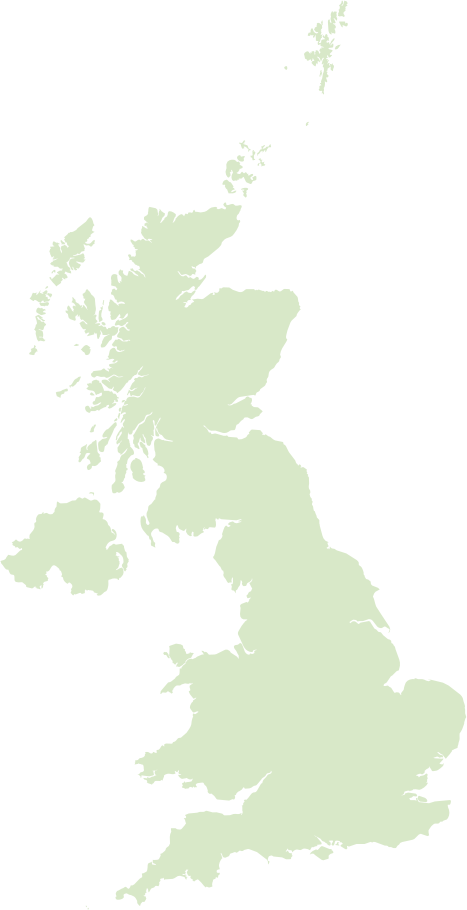
The Peak District National Park sits on the southern edge of the Pennines, largely within Derbyshire, and was the first national park created in England in 1951. Its character changes quickly from the moorland grit of the Dark Peak to the rolling limestone dales of the White Peak, with high plateaus and dramatic edges such as Kinder Scout, Stanage Edge and Mam Tor drawing walkers and climbers year‑round.
Under the surface there are caverns and show caves like Blue John Cavern and Peak Cavern, and a number of striking reservoirs such as Ladybower Reservoir that were built for industry and water supply. Pretty market towns and spa settlements - most famously Bakewell with its pudding and the spa town of Buxton - sit alongside hill farms and scattered villages such as Castleton, making the park both scenic and lived‑in.
Its history is industrial as well as pastoral: centuries of lead mining and quarrying left scars and archaeology, while the mills of the Derwent Valley Mills and the wartime dams at Derwent tell a story of national significance. Social history is also important here - the 1932 mass trespass on Kinder Scout was pivotal in securing countryside access rights, and grand estates like Chatsworth reflect another strand of local heritage.
Today the park’s economy depends on tourism, outdoor sports and hill farming, and local communities balance conservation with visitor pressure, second‑home ownership and the needs of modern livelihoods. The national park authority and local groups work on measures to manage traffic, protect habitats and support affordable housing so that the area remains both accessible to visitors and sustainable for residents.
Towns and villages in Peak District National Park
- Abney and Abney Grange Parish
- Aldwark Parish
- Alstonefield Parish
- Ashford in the Water Parish
- Bakewell Built-up area
- Bamford Built-up area
- Baslow Built-up area
- Baslow and Bubnell Parish
- Bonsall Parish
- Brassington Parish
- Chapel-en-le-Frith Parish
- Charlesworth Parish
- Chinley Built-up area
- Chinley, Buxworth and Brownside Parish
- Eyam Built-up area
- Froggatt Built-up area
- Glossop Built-up area
- Great Longstone Built-up area
- Hathersage Built-up area
- Hayfield Built-up area
- Holmesfield Parish
- Hope Built-up area
- Meltham Parish
- New Mills Parish
- Parwich Built-up area
- Saddleworth Parish
- Stocksbridge Parish
- Taddington Built-up area
- Tideswell Built-up area
- Whaley Bridge Parish
- Winster Built-up area
- Youlgreave Built-up area
Peak District postcode areas
DE4, DE6, DE45, HD7, HD9, OL3, S6, S10, S11, S17, S18, S32, S33, S35, S36, S42, SK10, SK11, SK12, SK13, SK17, SK22, SK23, ST10, ST13
Most populated places nearby
- Manchester 20 miles
- Sheffield 15.3 miles
- Stoke-on-Trent 25 miles
- Oldham 19.5 miles
- Mansfield 28.1 miles
- Huddersfield 23.1 miles
- Stockport 15.7 miles
- Salford 23.1 miles
- Newcastle-under-Lyme 27.5 miles
- Rotherham 19.8 miles
- Chesterfield 16 miles
- Wakefield 28 miles
Example postcodes in Peak District
DE45 1GX, S32 5AB, SK17 0TF, SK17 0NZ, DE4 2BZ, SK17 9SF, DE45 1LG, DE6 1RD, SK17 0LE … See all